
MiniStar Uniform Illuminator
Labsphere’s MiniStar Uniform Illuminator family combines our trusted integrating sphere technology with industry-leading LEDs to create a compact, uniform, and bright illumination source for transmittance testing and sensor characterization.
Uniformity PLUS Brightness for your Challenging Applications
High performance optical process monitoring may require the impeccable uniformity of MiniStar’s internal Lambertian surface coating. This uniformity enables:
• Consistent results at various angles
• Optical performance impervious to angular vibration
Spectra to Match Your Needs
The first entry in the MiniStar family has a broadband LED with spectral power distribution in the visible range (380 to 800+ nm), the MS12-25BB offers a 12 mm exit port with a 25 mm square footprint. New variations prioritized by customer interest include broadband CIE Illuminant and narrow-band monochrome sources from 300 nm – 1000 nm
Smooth Spectral Power Distribution
With a correlated color temperature of 7000K and nominally smooth power distribution over a wide hyperspectral wavelength range, this broadband source is ready for most visible light applications.
Key Applications
• Process control for glass or polymer production
• Quality and safety monitoring of food or pharmaceuticals
• Hyperspectral illumination for medical instrumentation
Challenges → Solved
• Mechanical instability & vibration can create false readings and demand more maintenance attention → Angular uniformity is less susceptible to beam alignment issues
• Fast imaging rate challenges real-time flat-field normalization → Spatial uniformity removes need for real-time normalization
• Low-E glass transmittance testing at solar peak (AM 1.5) → Continuous output through cyan gap (AM 1.5 470 – 510 nm)
• Evaluation of natural materials in the NIR “optical window” → Useful power output into NIR (>650 – 800 nm)
Contact for Pricing

Continuous Spectral Power Distribution with excellent coverage in the Cyan Gap and NIR bands

MiniStar bridges the “cyan gap” for more accurate transmittance testing
Glass and optical coatings: Automotive and architectural glass often have coatings that selectively block UV and IR but transmit visible light differently in the cyan region.
Display and filter testing: LCD, OLED, and AR coatings have spectral transmission specs that include this band.
Photonic components: Optical filters, lenses, and waveguides for imaging or laser systems often require precise transmission in this range.
Tinted or laminated glass manufacturing: Cyan wavelengths reveal differences in tint uniformity and interlayer absorption, impacting color matching, energy performance, and visual comfort.
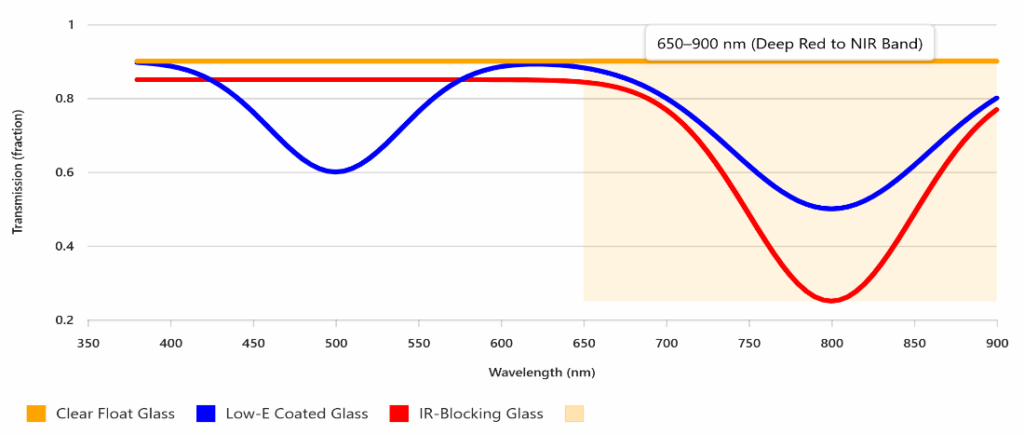
MiniStar LED source improves stability and longevity for NIR testing > 650 nm
Plastic and polymer inspection: NIR reveals internal layers or fillers in automotive parts, packaging, and films.
Food and pharmaceutical packaging: NIR transmissivity checks for particulate contamination or multilayer integrity.
Photonic and optical components: Filters, lenses, and coatings for laser systems often specify transmission in 650–900 nm for alignment or sensing.
Fill-Level: In many liquid medications, 700–850 nm light can pass through colored glass or plastic packaging that visible light cannot penetrate, allowing high-speed cameras to check the “fill line”.
Active Ingredient (API) Verification: NIR light can be transmitted through a whole tablet or capsule. By analyzing the resulting spectrum, manufacturers can confirm the concentration of the drug (API) and ensure there are no “cold spots” or uneven mixing within a single pill.
Fruit Ripeness & Internal Defects: In “Internal Quality” (IQ) sensors for apples, pears, and stone fruits, light in the 675–800 nm range is shone through the entire fruit. The amount of transmitted light tells the sorter the sugar content (Brix value) and detects “internal browning” or rot that isn’t visible on the skin.